Laugh at your life mistakes. In the end you are grateful for having them all.
Sunday, 16 November 2014
Sunday, 12 October 2014
No one understands me
Do not be upset, if people do not understand you. It means you know more than them. Use this knowledge to your own advantage. But don’t lose touch with reality.
Thursday, 3 July 2014
"Random" constant
123583145943707741561785381909987527965167303369549325729101
This constant is created by adding two last numbers in the sequence and making the next as the last digit of the sum: 1+2->3; 2+3->5; 3+5->8; 5+8->3, 8+3->1; ...
This constant has been created with the following ideas in mind.
1. It has to look random
2. It has be long enough so that the probability to match another random sequence is low
3. Easy to reproduce by a person with a pen and paper
4. Not based on any specific or personal information.
The length of this constant is 60 because after 60 digits the process repeats the sequence over again.
This constant is created by adding two last numbers in the sequence and making the next as the last digit of the sum: 1+2->3; 2+3->5; 3+5->8; 5+8->3, 8+3->1; ...
This constant has been created with the following ideas in mind.
1. It has to look random
2. It has be long enough so that the probability to match another random sequence is low
3. Easy to reproduce by a person with a pen and paper
4. Not based on any specific or personal information.
The length of this constant is 60 because after 60 digits the process repeats the sequence over again.
Sunday, 29 June 2014
Agression the eternal paradox
Can anyone justify aggression? Act of aggression or violence is always based on the idea of some future events. One can make reasonable justification when referring to something that will, can, or may happen. Now an interesting point is that all future events are always mental. They are never facts. An intelligent mind can foresee future events. Science makes great achievements. However those kind of events are never a base for aggression or violence because the models do not involve agents with intentional behaviour. When models do involve human players, the future events cease being facts. And said above justification becomes based on assumptions, strong or weak still assumptions, which are mere somebody's opinions.
Thursday, 17 April 2014
Chaitin Paradox
A known Chaitin's quote (*) can be succinctly expressed in a short phrase:
Understanding is programming
According to this statement, this very statement cannot be understood before we can program concepts: understanding and programming. If we were able to program these concepts, then it would be a discovery of true AGI. Hence the paradox is in the fact that its solution is not achievable before Technological Singularity.
(*) ... you understand something only if you can program it. (You, not someone else!) Otherwise you don't really understand it, you only think you understand it. [emphasis in the original]
Gregory Chaitin
Wednesday, 16 April 2014
Defective mind
It is really difficult to see your own mental deficiencies because our
brain is very good at making things up to look self-consistent. To find
out those one has to set his mind to scientific infinite cycle of
hypothesising, theorising, and experimenting.
But even starting with a hypothesis is hard. Look for clues of
inconsistency of your behaviour, beliefs and conclusions.
Wednesday, 12 March 2014
Memory
I can hardly bear confusion
And realise surreal
If all this is a mere illusion
Why does it feel so real
Monday, 16 December 2013
Programming and sex
Programming is like having sex: gives a lot of pleasure while doing when desired (like hobby), and is a nightmare when forced to (like work).
Saturday, 30 November 2013
Rat race
Life is a rat race. Sometimes you want to stop, but you cannot. The only thing you can do is to choose another track, and run with some other rats.
Tuesday, 26 November 2013
Killings in the World
All impersonal killings in the World are caused by either religion, or power, or money, but never science.
Tuesday, 30 July 2013
Saturday, 18 May 2013
Java and C++
Regardless how much I enjoyed programming in Java I have to admit that
For a disciplined programmer Java is worse than C++ in all possible respects.
That is not a mere assertion. I came to this conclusion after fair amount of programming in Java which I actually enjoyed. The underline is that Java represents a narrow stylistic paradigm which is just a specific style among many possible in C++. In all language constructions comparing to C++ Java limits the expressiveness to different levels without any semantic advantages.
A humorous analogy with a natural language would be: F is a rude word letter in English; let us remove all the words from English starting with the letter F, then adjust the grammar a little bit to compensate for the introduced deficiency, and then you have a new wonderful language English-a-la-Java, in which the kids cannot swear.
For a disciplined programmer Java is worse than C++ in all possible respects.
That is not a mere assertion. I came to this conclusion after fair amount of programming in Java which I actually enjoyed. The underline is that Java represents a narrow stylistic paradigm which is just a specific style among many possible in C++. In all language constructions comparing to C++ Java limits the expressiveness to different levels without any semantic advantages.
A humorous analogy with a natural language would be: F is a rude word letter in English; let us remove all the words from English starting with the letter F, then adjust the grammar a little bit to compensate for the introduced deficiency, and then you have a new wonderful language English-a-la-Java, in which the kids cannot swear.
Repetition in programming
Intelligence is never a repetition. In programming, repetition is the method not of ours.
Math love ladder
The love ladder of mathematics
1. I love math because it helps solve practical problems.
2. I love math because it is beautiful and I don’t care if it solves practical problems.
3. I love math because it is beautiful, I don’t care if it solves practical problems, but the evolution caused us to like beauty so eventually it is practical.
4. I love math because its beauty is in the beauty of our comprehension of the Universe and I do not care what the meaning of life is.
5. I don’t care!
1. I love math because it helps solve practical problems.
2. I love math because it is beautiful and I don’t care if it solves practical problems.
3. I love math because it is beautiful, I don’t care if it solves practical problems, but the evolution caused us to like beauty so eventually it is practical.
4. I love math because its beauty is in the beauty of our comprehension of the Universe and I do not care what the meaning of life is.
5. I don’t care!
Saturday, 19 January 2013
A hope for civilization of wise science
Be cautious of those who are afraid of changes. They are indeed who keep the control on you, who slave you with laws and rules. They are who steal your life quietly by putting you into the web of promises and obligations. They are who lure you into thinking that wars and killings in the world are things that just happen. They are who make money from every suffering, sick and dying person. They are who enclose you in the cocoon of fake values and ideas to limit your freedom and ability to think. They are who spy on you in your bewilderment. They retain our societies hold to ethics of greed, politics, and money. And chaos is the only sign that they fail sometimes.
Thursday, 27 September 2012
Fragility of Intelligence
I believe that Intelligence is an unstable phenomenon. The oxygen in the Earth’s atmosphere appeared within about two million years. On the Geologic time scale shrank to a meter it is less than a half a millimetre. Imagine how small will be the period on the Cosmological time scale between the time people started sending radio waves and the Technological Singularity (expected within this century) when the artificial intelligence exceeds human’s. Who knows how long it will take after the Singularity to stop spending valuable energy on radio wave dissipation up to the level of background radiation. This argument could resolve the Fermi paradox – the contradiction between the expectation of alien intelligent life and the absence of evidence of it.
Studying Nature
The humankind will survive only if it stops applying the knowledge about Nature to its mercantile and pragmatic applications.
Thursday, 30 August 2012
Seeing new
It is hard to see new. When seeing unusual we either see an analogy or a composition of well understood things.
Friday, 10 August 2012
The geatest crime of society
Differentiating people by general characteristics such as origin, beliefs, culture, social status and by that classifying them into large groups is the greatest crime.
Blame the Owner Not the Breed
One politician spoke dirty about another one. It was not a criminal offense. But how much resentment and anger it provoked in some blaming the offender! They just keep overlooking that the stain of the dirty remark falls on either one or the other depending on tolerance and approval of social surrounding. So blame the society or accept it as it is.
The I in the Universe
The Universe is much more significant than the I. Because the I is crackable and the Universe is not.
"In God's image, and after His likeness"
Think that God is like us? I don’t. I think God is very different that He does not have self-consciousness or personality. Otherwise He is just a mighty extraterrestrial.
Saturday, 4 August 2012
Wednesday, 21 March 2012
Life is a Pit
Life is a pit. You are thrown in. You slide down from one steep end. Then the slope becomes gradual and you reach the bottom point. After that you walk upward. Then climb. The further, the steeper. Until you push so hard that either you are too tired or you hit the wall, the other side of the pit. That is it. The life is all what’s behind you. And there is nothing more. Appreciate your pit. And fill it with love.
Simple Questions of Nature
Life and Nature consists of simple questions and simple answers. Its only their mosaic makes them look complex.
Wednesday, 14 March 2012
Copyright Is Greed
"...my objection to copyright of any kind..."
Leo Tolstoy, "Letter to the Free Age Press", 1900
Copyright protection is greed. Much can be said about the usefulness of copyright protection, but nevertheless it is greed. Greed can be basis for some aspects of society. Societies with a focus on greed are often more effective in achieving superiority over other societies, and as a consequence obtaining power over them. However getting the supremacy is also the aim of a society based on greed. So the usefulness of greed is measured by the effectiveness of achieving aims of the very same greed.
Thursday, 8 March 2012
Law of Truth Conservation
Truth is conserved in consistent systems. Consistent systems are those which do not produce any contradictions by internal logical inference. It is obvious that any consistent axiomatic base produce a consistent theory in which true statements remain true regardless of new theorems and conclusions. Less obvious but still easy to see that true statements remain true even if the system is expanded by new axioms or other statements that are not derived within the current theory as far as the expanded system remains consistent.
Interesting implication of this line of thought is that a person retaining consistency of hir views is not able to learn new facts contradicting hir system of beliefs even if the facts seems to be true. To change view one has to accept many contradicting to the current beliefs facts in order to build a new consistent outlook and reject or reassess old known facts. For example, if a particular view is supported by ten known facts, another hundred new facts are not able to flip over the view because each of new facts is rejected due to contradicting to the current view hence breaking the consistency.
Therefore as long as one maintains hir set of beliefs in consistency, truth is never going to change.
Wednesday, 7 March 2012
How you know that others have consciousness
First let’s ask a question how do you know that another person understands a particular concept in the same way as you do? You ask about different aspects of the concept and see if the answers correlate with your own answers to the same questions. It is possible that up to a point the answers may correlate well, but the person still has misunderstanding of the concept. If you realize this possibility you ask more questions to eliminate such case. Theoretically it is possible that after any length of communication the person still misunderstand the concept. But this would be highly impossible for long enough conversation. One can say that the assurance of mutual understanding asymptotically approaches to the full confidence (but never reaches it) to any upfront desirable level. In this sense it is valid to say that it is possible that one can be “completely” sure that there is no misunderstanding between communicating parties.
Secondly, having consciousness assumes a specific type of behaviour of a person or animal. When you realize correspondence between your own conscious behaviour and your behaviour perceived by others, you can project this correspondence on other people. Here I do not distinguish behaviour of a person and hir answers to questions. Now just by seeing the behaviour of another person for long enough time you may come to a conclusion that the other person has consciousness similarly as you do.
Finally, since the correlation between the reaction of a real person and the reaction of an imaginary conscious person making conscious decisions takes us to any degree of confidence that the real person has consciousness, it is impossible to create a zombie like mind mimicking conscious behaviour while lacking consciousness. In other words Searly’s weak AI is impossible and cannot exist.
Same files in OS
How long we have to wait until OS developers finally implement shared storage of duplicate files? Just imagine your OS without app installations and system rotting.
CapsLock and Password
This is a pretty stupid problem to me. All people suffer from it and will be suffering for a long time. Why not to allow both passwords to match: normal and CapsLocked? The only downside in this case is that brute force cracking time is halved. On the other hand, how many (in percentage) create passwords with capital letters! With the exponential complexity growth the register switch does make difference at all. Programmers of secure systems, please, be kind to their users!
Friday, 13 January 2012
Mind Existence Paradox
The more you think about vastness of the Universe, the more you think that Life and Mind must exist somewhere else as well. But they do not. The more you think about Life and Mind, the more you think that Life and Mind cannot exist at all. But they really do.
Wednesday, 11 January 2012
Science and Philosophy
Every Science starts with Philosophy and ends with it. If philosophers talk about something new, it is a sign that a new science is to be born. If philosophers talk about a particular science, be sure it will be dead soon.
Sunday, 1 January 2012
Statute of True Pirate
- Do not steal
- Assist against copyfucker attacks
- Do not buy and do not sell
- Do not lie except to copyfuckers
- Do not facilitate copyrighting
- Be free
- Do not ask and do not blackmail
- Do not renounce
- Share everything except your identity
First, True Pirate (TP) divides people in four groups:
- TPs – those who has deep belief in TP values and follow TP Statute
- Blokes – those of layman’s ideology, but supporting pirating and disapproving copyrighting
- Copyfuckers – copyrighting official representatives or anyone who facilitate copyrighting
- Herd – all others.
TP hate fiercely copyrighting and copyfuckers. This hate is not in their rules, but in their nature.
Second, TP divides the world into three concepts:
- Physical world – inanimate matter, that follows a conservation principle: if something somewhere reduces or disappears, then something somewhere increases or appears;
- Soul world – living matter, everything which is part of life or can be called alive or having mind;
- Information – bits that can be copied from one place to another without destroying the origin. This can be software, computer viruses, digitized works of art, or any other data written on medium.
TP believes that information is neither physical nor spiritual. And while spiritual beings can possess objects of physical world, they can only use information, but cannot forbid other beings to use that information as well. Hence no being can own information even if it is embedded in the medium which belongs to it. There are no copying restrictions on information in the Nature, except human society.
1. Do not steal. TP does not take private bits, something that is not intended to be released in public; if the owner has released bits to public they are not private anymore and can be freely copied.
2. Assist against copyfucker attacks. TP protects and defends as far as possible and to the best knowledge anyone against a copyfucker offence.
3. Do not buy and do not sell. TP does not buy or sell bits. However it is acceptable to buy and sell physical media or service of copying when the content of bits is irrelevant or does not have value.
4. Do not lie except to copyfuckers. Since TP does not recognise the supreme authority, his word should be law in relation to himself.
5. Do not facilitate copyrighting. TP watches his actions not to assist or participate in copyrighting even indirectly.
6. Be free. TP does not fulfil will of others. TP does not participate in creation of something which is intended to be sold.
7. Do not ask, and do not blackmail. TP copies whatever he wants never asking for permission. TP ignores any copyrighting notes even if they are anti-copyrighting. TP never asks for benefits threatening to reveal sensitive information to public. He reveals it immediately and unconditionally.
8. Do not renounce. TP has no fear to expose his beliefs.
9. Share everything except your identity. TP does not possess bits privately, unless they related to his own personal life.
Wednesday, 14 December 2011
Wellbeing
Health and Well-being are based on four elements:
- What you eat;
- What you breathe;
- What you think; and
- How you sleep.
Modern Society
Law and order of a modern society is rather illusory. A western "civilized" society is mostly based on chaos, negligence, and financial greed.
Thursday, 17 November 2011
Neuroscience
Those who do research in physics do so because they are too afraid to look in the face of reality: consciousness and neuroscience.
Monday, 14 November 2011
Carcinogenic Aloe
I read on wikipedia that Aloe vera is "potentially carcinogenic" (List of herbs with known adverse effects). Hmm, that made me thinking. The reference is "Should we be concerned about herbal remedies" 2001 by Memory Elvin-Lewis. But in that paper she just quotes another paper titled "Anthranoid laxative abuse--a risk for colorectal cancer?" 1993 by Siegers et al, which conclues that "Anthranoid-containing laxatives--aloe, cascara, frangula, and rheum--may play a role in colorectal cancer" using a quite controversial analysis. A quick search finds another paper "Anthranoid laxative use is not a risk factor for colorectal neoplasia: results of a prospective case control study" 2000, G Nusko et al, that says "Neither anthranoid laxative use, even in the long term, nor macroscopic or marked microscopic melanosis coli were associated with any significant risk for the development of colorectal adenoma or carcinoma". I wonder, who might be interested in discrediting herbs and in particular Aloe?
Follow up 28 Nov 2011
A few other wikipedia articles cite a paper "Vitamins and minerals: not for cancer or cardiovascular prevention" published in 2010. I could not find the text of the paper, but from the journal content list this paper is only half a page long, and it does not have the author! I cannot believe how statements made positively and negatively polarized depending whether they are about chemical drugs or natural approaches.
Another citation from the wikipedia article "Cancer": "Some studies have found that consuming lots of fruits and vegetables has little if any effect on preventing cancer". The paper, it is being referred to, says "A very small inverse association between intake of total fruits and vegetables and cancer risk was observed in this study. Given the small magnitude of the observed associations, caution should be applied in their interpretation.". I just wonder who wants to write "Some studies have found that consuming lots of fruits and vegetables has little if any effect on preventing cancer" referring to a paper which does not make that statement. However there lots of studies which prove that vegetarian diet significantly reduces, for example, risk of colon cancer.
Someone wants to sell drugs badly and in large amounts.
Follow up 28 Nov 2011
A few other wikipedia articles cite a paper "Vitamins and minerals: not for cancer or cardiovascular prevention" published in 2010. I could not find the text of the paper, but from the journal content list this paper is only half a page long, and it does not have the author! I cannot believe how statements made positively and negatively polarized depending whether they are about chemical drugs or natural approaches.
Another citation from the wikipedia article "Cancer": "Some studies have found that consuming lots of fruits and vegetables has little if any effect on preventing cancer". The paper, it is being referred to, says "A very small inverse association between intake of total fruits and vegetables and cancer risk was observed in this study. Given the small magnitude of the observed associations, caution should be applied in their interpretation.". I just wonder who wants to write "Some studies have found that consuming lots of fruits and vegetables has little if any effect on preventing cancer" referring to a paper which does not make that statement. However there lots of studies which prove that vegetarian diet significantly reduces, for example, risk of colon cancer.
Someone wants to sell drugs badly and in large amounts.
Thursday, 29 September 2011
Consciousness fusion: consciousness upload without brain scan
One of the known possible consciousness transfers is a gradual replacement of brain regions with artificial blocks. To me a problem with this approach is that even if the regions are small, there still must be the scanning procedure to extract not only functionality but the memory as well, because the brain has memory and it is stored in its network connections. Another problem in my opinion is that all this seems very unrealistic: keeping the brain alive and properly functioning with embedded artificial circuits.
There must be a simpler procedure to transfer the consciousness into the artificial brain. Start with a conscious but fairly empty artificial brain which is associated with a body similar to human, a robot. Now connect all sensory inputs from the robot to the real brain. At the same time shut down (or force to ignore) the sensory inputs of the real body keeping the real brain alive. Attach motor functions of the real brain to the robot. The artificial body of the robot is now governed by two independent minds: the artificial and the real. The artificial mind would be quite passive because of learning, so mostly the real mind would be responsible for the behaviour of the robot. After some short time the real mind starts to associate itself with a robot – with all its sensory inputs coming from and motoric functions acting through the robots body. After longer time the memory of life experience builds up synchronously in both minds the real and the artificial; although the real mind has its own memory baggage – the life before the connection. After even longer time, the percentage of pre-connection experience decreases. It might be possible to revoke older memories like it happens with a repeating recollection which overrides the older memory, hence moving the surrogate memories of older life to the artificial mind. At some moment the old memories of the real brain can be shutdown. Once this is done the system represents two identical minds one of which is real and the other is artificial. After this, switching off the real mind will not change the conscious state because that state is the same in both minds.
The net effect of all this process is a gradual transfer of the mind from the real brain into the artificial without conscious experience being interrupted. Obviously you would loose all your real memories obtained prior to connection. Is it worth it to live forever?
There must be a simpler procedure to transfer the consciousness into the artificial brain. Start with a conscious but fairly empty artificial brain which is associated with a body similar to human, a robot. Now connect all sensory inputs from the robot to the real brain. At the same time shut down (or force to ignore) the sensory inputs of the real body keeping the real brain alive. Attach motor functions of the real brain to the robot. The artificial body of the robot is now governed by two independent minds: the artificial and the real. The artificial mind would be quite passive because of learning, so mostly the real mind would be responsible for the behaviour of the robot. After some short time the real mind starts to associate itself with a robot – with all its sensory inputs coming from and motoric functions acting through the robots body. After longer time the memory of life experience builds up synchronously in both minds the real and the artificial; although the real mind has its own memory baggage – the life before the connection. After even longer time, the percentage of pre-connection experience decreases. It might be possible to revoke older memories like it happens with a repeating recollection which overrides the older memory, hence moving the surrogate memories of older life to the artificial mind. At some moment the old memories of the real brain can be shutdown. Once this is done the system represents two identical minds one of which is real and the other is artificial. After this, switching off the real mind will not change the conscious state because that state is the same in both minds.
The net effect of all this process is a gradual transfer of the mind from the real brain into the artificial without conscious experience being interrupted. Obviously you would loose all your real memories obtained prior to connection. Is it worth it to live forever?
Thursday, 22 September 2011
Fuck Google Maps Offline III
This is to replace two previous my posts "Maps Offline with Tile Viewer (part II)" and "How to browse Google Maps offline"
A few years ago I wrote my own tile viewer for viewing Google Maps tiles. Then I created a quite elaborate system for downloading tiles from Google servers. That all failed miserably. For the viewer I did not have much time for full application development. For the downloader I found that Google cleverly fights with such smart-asses like me. All in all I figured out that the simplest solutions are often the best. And below is the way I found practical for all my needs.
You need:
0 Working Internet Explorer (IE), if you are using Unix OS run it in Virtual machine
1. iegmsas console program
2. SAS.Planet (optional if you have your own tile viewer)
3. TrueCrypt (optional if you do not intent work with Tbytes of volumes)
Starting from the bottom up.
3. TrueCrypt is a program, which easily create a virtual hard drive. This program is necessary for the cache because if you have above 10-20 Gb of tiles moving the cache around becomes impractical. Instead TrueCrypt has all your cache in one file. If you are just starting creating you cache you can ignore this point at all and worry about it later.
2. SAS.Planet is a nice but crooked program for viewing and handling tiles. Its advantage is that it is the best program that exists, quite reliable, and with impressive functionality. A big disadvantage is that it is written in Russian and English version is way not too intuitive and user friendly. [Maybe it is done intentionally.] I am using the English version. It is very satisfactory once you get used to it. This program has its own built-in downloader for different map services including Google maps. But it does not work reliably because as I mentioned above Google knows about little fuckers and tries to prevent this kind of activity.
1. iegmsas is a simple console program which reads IE cache and steals tile files from there. You can download C++ source code here http://mazonka.com/bin/iegmsas.cpp or Windows executable here http://mazonka.com/bin/iegmsas.exe
* iegmsas takes two optional arguments N and T with default values 1 and 300 as
iegmsas 1 300
N is a number to check the IE cache; 0 for infinite loop;
T is the time delay between cache cheking
* iegmsas tries to read the directory HOMEDRIVE\HOMEPATH\Local Settings\Temporary Internet Files\
Which is correct on XP, but different on other Windows like Win7
To change the default path create a file 'iegmrip.in' and write in it a line
' C:\Documents and Settings\Davy\Local Settings\Temporary Internet Files\'
No quote marks. Mind 2 spaces at the front. Fix the user name and the cache path.
* iegmsas creates two directories 'cache' and 'gm' where tiles are copied. The first directory stores the tiles in the format for SAS.Planet. The second directory 'gm' stores the tiles in the format for OMTileViewer. So basically files are duplicated in these directories. The only important difference is that only 'gm' directory is checked by iegmsas before copying new tiles. So if you remove 'gm' directory iegmsas will copy all tiles from IE cache.
0. IE can be left with arrow key pressed if you press an arrow key and the press Alt or another key not releasing the arrow key. If you need a more elaborate navigation send me e-mail, and I will send you programs which make IE navigate in more complex way, for example, follow the roads.
A few years ago I wrote my own tile viewer for viewing Google Maps tiles. Then I created a quite elaborate system for downloading tiles from Google servers. That all failed miserably. For the viewer I did not have much time for full application development. For the downloader I found that Google cleverly fights with such smart-asses like me. All in all I figured out that the simplest solutions are often the best. And below is the way I found practical for all my needs.
You need:
0 Working Internet Explorer (IE), if you are using Unix OS run it in Virtual machine
1. iegmsas console program
2. SAS.Planet (optional if you have your own tile viewer)
3. TrueCrypt (optional if you do not intent work with Tbytes of volumes)
Starting from the bottom up.
3. TrueCrypt is a program, which easily create a virtual hard drive. This program is necessary for the cache because if you have above 10-20 Gb of tiles moving the cache around becomes impractical. Instead TrueCrypt has all your cache in one file. If you are just starting creating you cache you can ignore this point at all and worry about it later.
2. SAS.Planet is a nice but crooked program for viewing and handling tiles. Its advantage is that it is the best program that exists, quite reliable, and with impressive functionality. A big disadvantage is that it is written in Russian and English version is way not too intuitive and user friendly. [Maybe it is done intentionally.] I am using the English version. It is very satisfactory once you get used to it. This program has its own built-in downloader for different map services including Google maps. But it does not work reliably because as I mentioned above Google knows about little fuckers and tries to prevent this kind of activity.
1. iegmsas is a simple console program which reads IE cache and steals tile files from there. You can download C++ source code here http://mazonka.com/bin/iegmsas.cpp or Windows executable here http://mazonka.com/bin/iegmsas.exe
* iegmsas takes two optional arguments N and T with default values 1 and 300 as
iegmsas 1 300
N is a number to check the IE cache; 0 for infinite loop;
T is the time delay between cache cheking
* iegmsas tries to read the directory HOMEDRIVE\HOMEPATH\Local Settings\Temporary Internet Files\
Which is correct on XP, but different on other Windows like Win7
To change the default path create a file 'iegmrip.in' and write in it a line
' C:\Documents and Settings\Davy\Local Settings\Temporary Internet Files\'
No quote marks. Mind 2 spaces at the front. Fix the user name and the cache path.
* iegmsas creates two directories 'cache' and 'gm' where tiles are copied. The first directory stores the tiles in the format for SAS.Planet. The second directory 'gm' stores the tiles in the format for OMTileViewer. So basically files are duplicated in these directories. The only important difference is that only 'gm' directory is checked by iegmsas before copying new tiles. So if you remove 'gm' directory iegmsas will copy all tiles from IE cache.
0. IE can be left with arrow key pressed if you press an arrow key and the press Alt or another key not releasing the arrow key. If you need a more elaborate navigation send me e-mail, and I will send you programs which make IE navigate in more complex way, for example, follow the roads.
Tuesday, 13 September 2011
Believing in Strong AI
People not believing in Strong AI will exist even after the technological singularity like all those who still believe in immortal soul.
Monday, 12 September 2011
Questions, questions...
There are questions which are difficult to answer. Inquiring mind trying to be consistent answers them according to its own culture, not science. The very concept of knowledge fails in such areas of cognition.
Question 1. What is the ultimate cause of everything? What is the creator of the Universe? If the beginning of the universe had a creator then who is the creator of the creator? If the creator made himself, what is the reason of such creation?
Question 2. Is there any mind in the Universe different from ours? Another mind may be different so much that interaction with it may be impossible or virtually impossible.
Question 3. Is the Universe controlled by determinism? Quantum physics tells us that quantum processes are fundamentally non deterministic for any observer. So the question is, is it non-deterministic for the Universe itself as well?
Question 4. Is there free will in a deterministic world? Assuming, that the quantum world is not needed for explanation of intelligence and consciousness, how certain laws create your own personal free will?
Question 5. How the past can be multiple? The double-slit experiment proves multiple histories ....
Question 1. What is the ultimate cause of everything? What is the creator of the Universe? If the beginning of the universe had a creator then who is the creator of the creator? If the creator made himself, what is the reason of such creation?
Question 2. Is there any mind in the Universe different from ours? Another mind may be different so much that interaction with it may be impossible or virtually impossible.
Question 3. Is the Universe controlled by determinism? Quantum physics tells us that quantum processes are fundamentally non deterministic for any observer. So the question is, is it non-deterministic for the Universe itself as well?
Question 4. Is there free will in a deterministic world? Assuming, that the quantum world is not needed for explanation of intelligence and consciousness, how certain laws create your own personal free will?
Question 5. How the past can be multiple? The double-slit experiment proves multiple histories ....
Tuesday, 6 September 2011
Theory, reality, and a white car
I have a theory that my car is white. The facts are that my car was white when I was buying it. Yesterday it was white, and every day earlier I saw it being white. Now the prediction of my theory is that tomorrow my car will still be white, because I have a law in my theory that my car is white always. This theory is not reality, it is just a theory. Because it might happen that the car will get painted to some other colour. In that case my theory would fail. The law would be broken by reality.
My theory is that the words: theory, knowledge, memory, word, concept have one root of meaning. Every word in a language is some kind of theory with its predictive power. We use language constructs to model the reality only eventually to be able to make predictions. In situations when we can descent to greater details of the model, more precise description is possible; for example, science theories. In other cases when the model is difficult to break into composites, we invent a concept, label it with a word, and use that word in a context to pass the information about future events; for example, knowledge or thoughts. I think that my car is white. Here I pass the model of my perception of the car. You would be surprised to see me not surprised seeing that my car is not white, because I told you that I think it is white, unless I lied. Lie is another concept quite different from think. In your model of me you may assume that I may sometimes lie. So your prediction of future events consists of many theories and concepts put together. The scientific method is built in our language, which appears to be the only way to describe the reality, via models and theories even if the models and theories do not look like models and theories in their usual meaning.
My theory is that the words: theory, knowledge, memory, word, concept have one root of meaning. Every word in a language is some kind of theory with its predictive power. We use language constructs to model the reality only eventually to be able to make predictions. In situations when we can descent to greater details of the model, more precise description is possible; for example, science theories. In other cases when the model is difficult to break into composites, we invent a concept, label it with a word, and use that word in a context to pass the information about future events; for example, knowledge or thoughts. I think that my car is white. Here I pass the model of my perception of the car. You would be surprised to see me not surprised seeing that my car is not white, because I told you that I think it is white, unless I lied. Lie is another concept quite different from think. In your model of me you may assume that I may sometimes lie. So your prediction of future events consists of many theories and concepts put together. The scientific method is built in our language, which appears to be the only way to describe the reality, via models and theories even if the models and theories do not look like models and theories in their usual meaning.
Thursday, 25 August 2011
Pedagogical advice
If you ask someone to do a particular job, then that person subconsciously bears in mind that taking care of this job is your responsibility, hence less likely taking the initiative in the future. This works especially apparently with children.
Thursday, 18 August 2011
On Memory 2
Memory is information. Information has sense. Sense is only included in the future. Different senses cause different futures.
The past is one. Futures are many. Every possible branch of the future is defined by the conscious selection of an organism. The conscious selection of the organism is defined by its prediction of the future, and this prediction is the sense of the information.
Hence the past and the future are linked through the prediction of organisms, the sense of information which forms the organism's memory.
An active agent, organism, submerged into the environment possesses information about the environment forming its memory. Since no organism is programmed by a (or the) creator, that information is the only product of the environment allowing us to distinguish the organism from the environment.
To me, the separation between the past and the future, and between the organism and the environment is only a perceptional effect. In reality it is just one entity like one building viewed from different angles.

The past is one. Futures are many. Every possible branch of the future is defined by the conscious selection of an organism. The conscious selection of the organism is defined by its prediction of the future, and this prediction is the sense of the information.
Hence the past and the future are linked through the prediction of organisms, the sense of information which forms the organism's memory.
An active agent, organism, submerged into the environment possesses information about the environment forming its memory. Since no organism is programmed by a (or the) creator, that information is the only product of the environment allowing us to distinguish the organism from the environment.
To me, the separation between the past and the future, and between the organism and the environment is only a perceptional effect. In reality it is just one entity like one building viewed from different angles.

Little wrongness amongst many
In confrontation the easiest situation is when your enemy is wrong. How frustrating it is when your opponent is almost right and wrong just a little; and this wrongness is supported by many. That always have devastating effect which everyone understands to be wrong, but no one seems to understand why. Little wrongness among many builds up, pours itself out in immoral actions or simple stupidity which cannot be fought.
Friday, 3 June 2011
Life and Science
Science is an aspiration to increase knowledge by any opportunity. Life is an aspiration to increases its presence by any opportunity. Things which can be copied must be copied.
Friday, 20 May 2011
Road for a thought
With age the mind becomes more like a highway: thoughts move much faster, but leave no trails.
Tuesday, 17 May 2011
Real art
Real art must not only be useless, it must also be incorrect to ensure no possible practicality in the future.
Tuesday, 22 March 2011
Principles of relativity
1. Relative Motion
If you move in uniform motion relative to some surface and the surface is perfectly smooth, then you cannot make a physical experiment to find out whether you move or not.
2. Uniform Motion
If you do not have objects of reference, you cannot make a physical experiment to find out whether you move or not.
3. Special Relativity
If two events A and B take place so that A happens after the point in time necessary for light to reach from A one to B, but earlier than the point in time necessary for light to reach from B to A, then you cannot make a physical experiment to find out which event happened earlier and which later.
4. General Relativity
If you do not have objects of reference and experience inertial force, you cannot make a physical experiment to find out whether the force is caused by acceleration or gravitation.
These principles have so beautiful symmetry that it is difficult to imagine that they are not true. However the first one is obviously false because the surface must be made of atoms. Only in an imaginary universe where the matter can be continuous this principle holds. The second is the Galilean invariance. And the last two are Einstein’s.
If you move in uniform motion relative to some surface and the surface is perfectly smooth, then you cannot make a physical experiment to find out whether you move or not.
2. Uniform Motion
If you do not have objects of reference, you cannot make a physical experiment to find out whether you move or not.
3. Special Relativity
If two events A and B take place so that A happens after the point in time necessary for light to reach from A one to B, but earlier than the point in time necessary for light to reach from B to A, then you cannot make a physical experiment to find out which event happened earlier and which later.
4. General Relativity
If you do not have objects of reference and experience inertial force, you cannot make a physical experiment to find out whether the force is caused by acceleration or gravitation.
These principles have so beautiful symmetry that it is difficult to imagine that they are not true. However the first one is obviously false because the surface must be made of atoms. Only in an imaginary universe where the matter can be continuous this principle holds. The second is the Galilean invariance. And the last two are Einstein’s.
Monday, 14 March 2011
Memes war
Evolutionary principle of information propagation is universal. Starting from a simple hydrodynamic turbulence and stretching to more complex systems in chemistry, biology, genetics and politics, informational entities procreate as soon as new area suitable for existence is recognized.
In this sense biological organisms are not much different from turbulence vortices. When liquid changes its state from laminar to turbulent, there is a point of instability where an appearance of one vortex cause an avalanche process of recreating vortices first in the neighbor area and finally in the whole volume. One can say that a vortex wants to reproduce. Later they can fight for space killing each other and reproducing whenever possible.
Memes use people as an environment. When mutually exclusive memes clash and fight for survival the most effective solution is to eliminate the enemy meme habitat, i.e. a person who has an incompatible belief. Less severe measures are possible, but they are less effective. As long as people possess mutually exclusive memes, there will always be violence and wars.
Memes as any other evolving things do cooperate to fight common enemies. This cooperation assumes acceptance to some extent to foreign memes. Another acceptance can be to non-hostile or irrelevant memes.
In this sense biological organisms are not much different from turbulence vortices. When liquid changes its state from laminar to turbulent, there is a point of instability where an appearance of one vortex cause an avalanche process of recreating vortices first in the neighbor area and finally in the whole volume. One can say that a vortex wants to reproduce. Later they can fight for space killing each other and reproducing whenever possible.
Memes use people as an environment. When mutually exclusive memes clash and fight for survival the most effective solution is to eliminate the enemy meme habitat, i.e. a person who has an incompatible belief. Less severe measures are possible, but they are less effective. As long as people possess mutually exclusive memes, there will always be violence and wars.
Memes as any other evolving things do cooperate to fight common enemies. This cooperation assumes acceptance to some extent to foreign memes. Another acceptance can be to non-hostile or irrelevant memes.
Wednesday, 9 February 2011
Pull and Push Requirements Revisited
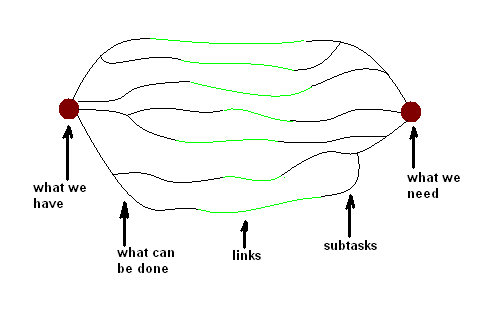
Architecting is bringing together two entities: what we have and what we need.
What we have can be improved and modified in a number of ways both simultaneous and mutually exclusive. You can imagine a tree of paths starting from one node. The node is what we have. The branches are what can be done about or with it.
The same situation is with the other pole – what we need. If it’s a node, then the branches coming out of this node are the possible objectives which if achieved can deliver what we need.
The architect work is to build the branches and link the branches from the different sides. Building architecture for complex systems is a hard work, often not achievable in the original idea. I find it important to identify five directions of thoughts: what we have, what we need, what can be done, ingredients of what we need, and the grey area of linking.
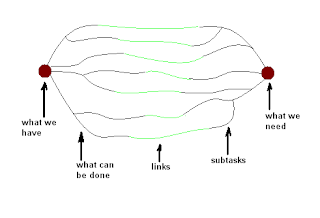
What we have can be improved and modified in a number of ways both simultaneous and mutually exclusive. You can imagine a tree of paths starting from one node. The node is what we have. The branches are what can be done about or with it.
The same situation is with the other pole – what we need. If it’s a node, then the branches coming out of this node are the possible objectives which if achieved can deliver what we need.
The architect work is to build the branches and link the branches from the different sides. Building architecture for complex systems is a hard work, often not achievable in the original idea. I find it important to identify five directions of thoughts: what we have, what we need, what can be done, ingredients of what we need, and the grey area of linking.
Monday, 24 January 2011
Evolution without natural selection
I find the idea that evolution is possible without natural selection fascinating!
Suppose that there is a fixed number of species with equal number of male and female and exactly the same length of life for all species. Each pair produce two offspring male and female keeping the perfect balance of the whole population. Now is the question: is evolution possible in this scenario? One answer is no, because there are no natural selection and no preference is given to one carrier of genes before another.
If genes are taken from the parents in exactly random way then each parent pair pass 75 per cent of their genes to their offspring, because it is 50 percent from each parent to each child, so 25 percent is shared between two offspring. It means that with each generation a quarter of all genes are lost. However due to genes variety and enough repetition within the whole population, the number of distinct genes may not be decreasing. If there are random mutations in genes the variety can increase. In the other case when passing genes is not fully random, less than 75 per cent is being passed, so the washing out of genes is even faster.
Suppose however that there is a mechanism which marks genes of the individual as better or worse. If two genes one from each parent fight for the place to be in the descendant based on their marked value, then better genes are passed to the next generation and worse genes will be lost. In this case the natural selection happens on the level of genes and not on the level of species. Overall trend is that each generation has better genes even that no preference is given to any creature during its life.
Obviously there are two questions here. First what is that mechanism which makes genes to be marked and compete? And second, what means a better gene? Or in other words, how the organism decides which gene to reward and which to punish? Let them to be open. What is interesting is that evolution happens in a completely perfect and stable environment for species.
If something like this happens in reality, the main reason for this probably is the elimination of undesirable mutations in genes.
Suppose that there is a fixed number of species with equal number of male and female and exactly the same length of life for all species. Each pair produce two offspring male and female keeping the perfect balance of the whole population. Now is the question: is evolution possible in this scenario? One answer is no, because there are no natural selection and no preference is given to one carrier of genes before another.
If genes are taken from the parents in exactly random way then each parent pair pass 75 per cent of their genes to their offspring, because it is 50 percent from each parent to each child, so 25 percent is shared between two offspring. It means that with each generation a quarter of all genes are lost. However due to genes variety and enough repetition within the whole population, the number of distinct genes may not be decreasing. If there are random mutations in genes the variety can increase. In the other case when passing genes is not fully random, less than 75 per cent is being passed, so the washing out of genes is even faster.
Suppose however that there is a mechanism which marks genes of the individual as better or worse. If two genes one from each parent fight for the place to be in the descendant based on their marked value, then better genes are passed to the next generation and worse genes will be lost. In this case the natural selection happens on the level of genes and not on the level of species. Overall trend is that each generation has better genes even that no preference is given to any creature during its life.
Obviously there are two questions here. First what is that mechanism which makes genes to be marked and compete? And second, what means a better gene? Or in other words, how the organism decides which gene to reward and which to punish? Let them to be open. What is interesting is that evolution happens in a completely perfect and stable environment for species.
If something like this happens in reality, the main reason for this probably is the elimination of undesirable mutations in genes.
Thursday, 13 January 2011
On Memory
You know what is memory. It is in your memory. But what is it? It is defined vaguely as 1) something remembered; 2) preserved data for retrieval. How do I know that someone has memory? It is simple - if his behaviour adequate to his past experience. But what if that someone does not reveal any behaviour? In such case to assert that the memory exists is problematic. In the simplest case the memory is a table device with input and output entries. For any particular input the device manifests output. In a computer, memory input is the address of a memory cell and output is the value stored in the memory cell. Note that in computer computation it is important that the addresses in memory are associated with each other by arithmetic operations; otherwise no useful computations would be possible.
Behaviour or output is necessary in memory definition. If no behaviour present (for example one cannot extract values from the memory) then it does not matter whether a device has anything in its memory or not. For an external observer memory is not present.
Time is necessary for memory definition. Memory links two events distant in time. And the opposite is true, if two events distant in time are linked, then there memory exists.
Space is required for memory associations. Different memories can be liked in space by association. In other words memory about memory maps time link into space link. The most interesting thing here is that mapping back space link into time link can be done arbitrary by a device. For example time can shrink or be reversed. In the first case, the device reveals ability to predict and in the second to infer.
Behaviour or output is necessary in memory definition. If no behaviour present (for example one cannot extract values from the memory) then it does not matter whether a device has anything in its memory or not. For an external observer memory is not present.
Time is necessary for memory definition. Memory links two events distant in time. And the opposite is true, if two events distant in time are linked, then there memory exists.
Space is required for memory associations. Different memories can be liked in space by association. In other words memory about memory maps time link into space link. The most interesting thing here is that mapping back space link into time link can be done arbitrary by a device. For example time can shrink or be reversed. In the first case, the device reveals ability to predict and in the second to infer.
Wednesday, 17 November 2010
It
In darkness my vice
Is a simple device
It's almost alive
To the way I contrive
The life is profuse
But too easy to lose
I wish I don't die
When It calls itself I
Is a simple device
It's almost alive
To the way I contrive
The life is profuse
But too easy to lose
I wish I don't die
When It calls itself I
Monday, 1 November 2010
Unfree Will Paradox
Hello. I am a machine, robot. My Master is doing an experiment with me. They ask me to choose between two doors A and B. Death awaits me behind one of the doors. And I do not want to choose that one. The difficult part is that the master made a clone of me previously and did this experiment with my clone. Now Master put Death behind the door my clone have had chosen. So if my clone chose the door A, then Death is behind the door A. I cannot use any environment information to make my decision, only my internal reasoning – that is part of the experiment.
Had the clone not been told that he also had a clone, he would have chosen the door A; then I have to choose B. But if the clone had been told that he had been cloned as well and the clone of the clone did not known about being cloned, then my clone’s selection must be B and my selection have to be A. This means that my selection must depend on the depth of knowing which of the clone’s clone did not know about being cloned - whether it is odd or even.
Tuesday, 12 October 2010
New York Game, Alien Test, and Pain - Random
New York Game
The brain makes mistakes. Mistakes are not a deficiency of the brain work, but its quality. They reveal a little bit how the brain works. This is not a game, rather a trick we did to each other when being kids. One asks another to constantly repeat the word “New York” and then answer a question as quickly as possible when suddenly asked. The question was what the capital of the USA is. We all new that the capital of the USA is Washington, but not perfectly – you had to have a second to think (we lived in SU and were kids!). The answer was “New York”. But when told it is not correct, one who answered was really surprised that he made a mistake to such a simple question.
The same mechanism of the mistakes exposed when you make a mistake when typing. Very often (at least to me) one types a letter of the word following the currently typing. This is because the task of pressing keys is interfered with highly active predictions of the next word.
Alien Test
When you see an alien how would you know that it is intelligent? What is the simplest communication which lets you know that the other side can think? I could not find any simpler way than the following. Present to it a sequence of 5 symbols (spatially or temporally) where the first and the second symbols are the same, and the third and the forth symbols are the same too, and the fifth is different, for example, AABBC. If the reply is the repetition of the fifth symbol, then (assuming a counter test that it is not just a repetition of the last symbol) the replying entity is able to process abstract patterns, which is a necessary condition. Processing abstract patterns may well be necessary and sufficient condition for a living intelligent alien, but probably not sufficient for an artificial intelligence. Because it is easy to write a computer program to pass this test which cannot be called intelligent.
Pain
Do you feel the pain? When you feel the pain what do you feel about feeling the pain? An interesting question arises if one thinks about the pain as a memory. If someone undergoes an operation under anaesthetics and does not remember feeling any pain during the operation, does it matter if the person felt the pain but forgot about it or did not feel the pain at all? What if we are unable to distinguish between these two? Now change the time of pain erasing from the memory from zero to infinity. The fact that the person felt the pain is true as along as he remembers it. But when the memory is erased the pain has not happened anymore.
Tuesday, 5 October 2010
Maps Offline with Tile Viewer (part II)
See Update Fuck Google Maps Offline III
Offline Maps Tile Viewer is a program I created quickly to use my netbook for viewing google maps without a network connection. I found frustrating not to be able to have full control over the cached images using web browser or google earth. Other different offline map viewers did not satisfy me.
My requirements were simple: there are a number of square (or rectangular) images which can be tiled together to construct a huge image; a viewer must have a viewing area moving around over this huge image; images can have different layers (as satellite, maps, topo etc) and different scales better or worse resolution; it should be possible to geographically reference them, i.e. have latitude/longitude coordinates associated with a position on the image. Cross referencing is necessary to switch between different resolution scales - hence geo-referencing is a natural way for that. Also images should not have some strict predefined format or organization, it is just a collection of small images named and grouped in directories in a particular way.
Download here.
It might not be very easy to start with it, but once you understand how it works, it gives you full flexibility of what is required from a simple map browsing program. You can even add GPS dongle and bind the viewer with the position obtained from GPS.
One of the delicate problems is maps itself. It is very easy to download automatically (more on this here)
from google maps; but it is not very polite, and distributing is not too.
Offline Maps Tile Viewer is a program I created quickly to use my netbook for viewing google maps without a network connection. I found frustrating not to be able to have full control over the cached images using web browser or google earth. Other different offline map viewers did not satisfy me.
Download here.
It might not be very easy to start with it, but once you understand how it works, it gives you full flexibility of what is required from a simple map browsing program. You can even add GPS dongle and bind the viewer with the position obtained from GPS.
One of the delicate problems is maps itself. It is very easy to download automatically (more on this here)
from google maps; but it is not very polite, and distributing is not too.
Friday, 17 September 2010
Pyramidal intelligence
Consciousness is an intelligence phenomenon. The intelligence is based on three interconnected functions: language, abstract thinking, and self-awareness. Those three are just internal mechanisms which have their own place in neural processing. In this sense consciousness and self-awareness are two distinct concepts, which some confuse. Self-awareness is a placement of self into the internal model of the world, but consciousness is kind of side effect of intelligence. Consciousness is responsible for conscious behaviour and decisions which is pertained only to intelligent entity. Unintelligent robot or animal cannot make conscious decision although it can possess self-awareness.
"Saccade hypothesis" is an important detail when modelling information processing. In this processing predictions are models of the environment. Predictions are hardwired to the higher order motor levels bringing the environment into the loop of the information circle. So "saccades" and behaviour allow to keep the current model activated, inhibiting all potential concurrent models. One noticeable effect of this is when you stare for a while at a wall you can see come patterns or pictures, but once you move your eyes the images disappear.
If the prediction is wired to behaviour, then 'free will' is automatically shifted into prediction area. In other words we chose what to do next by thinking what happens next. That makes sense because we do whatever we think we will be doing. A thought of moving arm moves the arm. But a thought of it is a prediction of the current active model. That is how micromovements manifest suppressed actual movements.
In this view conscious behaviour of people and behaviour of animals are based on the same principle, and the processing of information is exactly the same. This is why our brains have the same structure. The difference is only at the level of abstraction in the model of the environment. A human brain can consume or process more abstract models (even the models created by itself) due to sufficient cortical capacity.
"Saccade hypothesis" is an important detail when modelling information processing. In this processing predictions are models of the environment. Predictions are hardwired to the higher order motor levels bringing the environment into the loop of the information circle. So "saccades" and behaviour allow to keep the current model activated, inhibiting all potential concurrent models. One noticeable effect of this is when you stare for a while at a wall you can see come patterns or pictures, but once you move your eyes the images disappear.
If the prediction is wired to behaviour, then 'free will' is automatically shifted into prediction area. In other words we chose what to do next by thinking what happens next. That makes sense because we do whatever we think we will be doing. A thought of moving arm moves the arm. But a thought of it is a prediction of the current active model. That is how micromovements manifest suppressed actual movements.
In this view conscious behaviour of people and behaviour of animals are based on the same principle, and the processing of information is exactly the same. This is why our brains have the same structure. The difference is only at the level of abstraction in the model of the environment. A human brain can consume or process more abstract models (even the models created by itself) due to sufficient cortical capacity.
Friday, 7 May 2010
Multiculturalism
There is an unclear area in the term multiculturalism. Multiculturalism is promoted as a beneficial feature for a society. What people often miss is its application to a community. Community is a number of interacting individuals. And the community has to be multicultural, not a society composed of multicultural communities. If this is not understood clearly enough, it appears to be a big dilemma by the promoters of multiculturalism.
In other words I would like to live with my neighbours being from different cultural backgrounds assuming that our neighbourhood is a community. But I do not want to live in society broken by different communities on cultural basis.
In other words I would like to live with my neighbours being from different cultural backgrounds assuming that our neighbourhood is a community. But I do not want to live in society broken by different communities on cultural basis.
Electrons and Qualia
One of the conclusions from my previous post is that no idea or concept inside a human mind can be expressed in one hundred percent precision. Language is a mechanism for putting thoughts into sentences. A sentence is only a projection of a thought; in the same way as two dimensional images in our retina are projections of three dimensional objects. But the brain does not usually have problems to reconstruct the real objects. This provokes a question: what is a real object? Take, for example, an electron. We can distinguish one electron from another, because they may occupy different parts of space. However there is no way to distinguish them if you exchange their positions. That means that the electron is really the same at this place and at another place. Now, is it really two different electrons, or just one, the same electron appearing to us at two different places? There is no answer to this question. You can only believe in one or the other way. If it is the same electron at different places, then in our perception it is equivalent to a pattern. Suppose you look at a sequence of numbers, and you notice a particular pattern in that sequence. Does the pattern really exists or is it your brain that creates that concept? As far as you can differentiate something (electron, pattern) from something another, this is a real concept which can verbally be transferred using language. But this concept can be expressed only as a difference, not the concept itself. It is the same as you are not able to explain what red colour is, but you can show and confirm with others that you can differentiate red and green colours. So if you loose, for some reason ability to differentiate positions (plus maybe some other quantum states such as momentum and spin) of electrons, then a particular electron would become a quale - a not expressible concept like red colour! Then if electron, the basic element of the material world, can be a quale, what is the material world? Qualia?
Wednesday, 28 April 2010
Space, Information, and Consciousness
Correlations in space are objects.
Objects exist in time.
Correlations in time is memory.
Memory exists as information.
Correlations in information are abstractions.
Abstractions are expressed in language.
Correlations in language are concepts.
Concepts exist in minds.
Correlations in minds is consciousness.
Objects exist in time.
Correlations in time is memory.
Memory exists as information.
Correlations in information are abstractions.
Abstractions are expressed in language.
Correlations in language are concepts.
Concepts exist in minds.
Correlations in minds is consciousness.
Thursday, 18 February 2010
Faces of consciousness and free will
1. Self-awareness is contemplating self inside the model of the world. It is like you watching a chess board with all the pieces moving by themselves except one piece which moves at your will. This builds strong association between the perceived object and self. This piece you call 'I'. 2. Conscious behaviour is a prediction of the future of the world model with implications of the potential action of 'I'. You may drive a car unconsciously. But when a policeman stops you, you immediately become aware of all possible future scenarios of the current situation. Hence what you are about to do is a conscious decision. 3. Conscience is the ethical judgement of personal actions and thoughts. It is not only a perception of the facts, but also colouring them and placing on the scale of desirable and undesirable. Conscience is not really consciousness since it serves for establishing moral dogmata in relation to the behaviour. 4. Free will phenomenon appears on two levels. On micro-scale, actual movements and other muscle control is the result of a mental decision made by brain. A free will sense on this level comes from self-awareness. On macro-scale, deeds or life decisions are the result of conditional beliefs and circumstances. The beliefs or truths are a remembered result of combining the information coming from outside and internal emotional state and feelings. The truths are formed inside during the life and they condition our behaviour.
Wednesday, 27 January 2010
On consciousness
What is the difference between conscious and unconscious action? Unconscious action is autonomous. It is executed according to a set of rules, although the action may be quite complex. Conscious action has a context – the environment, in which it takes place. Conscious action happens only after modelling of consequences. It implies perception of the implications in advance.
Unconscious actions are not remembered, but conscious are. Why? Because the brain cannot predict the result of the modelling: it can predict environment, but it cannot predict its own imagination. So unpredicted experience is recognized as valuable and remembered.
Why do I have only one consciousness in my head? Can I develop two and allow them to communicate? Indeed, if a part of cortex can model, predict, and imagine the environment why it cannot develop its own conscious behaviour? Or maybe we have multiple conscious agents in our head, but they so aligned with each other that they are not distinguishable. Have you ever heard voices in your head?
Unconscious actions are not remembered, but conscious are. Why? Because the brain cannot predict the result of the modelling: it can predict environment, but it cannot predict its own imagination. So unpredicted experience is recognized as valuable and remembered.
Why do I have only one consciousness in my head? Can I develop two and allow them to communicate? Indeed, if a part of cortex can model, predict, and imagine the environment why it cannot develop its own conscious behaviour? Or maybe we have multiple conscious agents in our head, but they so aligned with each other that they are not distinguishable. Have you ever heard voices in your head?
Tuesday, 12 January 2010
What is Intelligence
you understand something only if you can program it (Chaitin)
Intelligence is Abstract thinking plus Language plus Consciousness. Although all three are not independent, they can be understood in simple definitions.
Abstract thinking is thinking in terms and concepts produced by mind, not sensors. The world mind perceives mostly consists of introspective data.
Language is an agreement between communicating parties. Language serves as a port between the mind and the world.
Consciousness is perception of the abstract representation of self in the world.
The world is the model which the mind builds and holds to predict its future state.
Self is the object in the world the mind has control on. Self does not have well defined boundaries, for example, a governor may associate himself with a state.
Knowledge requires memory. Knowledge transfer requires language. Language is a simpler concept because it can be seen as a collection of symbols or rules. Knowledge is more complex because it is bound to language and behaviour. Any attempt to define knowledge immediately brings up a language. For example, storing any meaningful data requires some format, which is a language. But when we talk about knowledge, language is not necessary. For example, an ant knows where to crawl and does not need a language.
To a simple question "What is memory?" the dictionary answers "The ability to recover information about past events or knowledge" or "a part of a computer in which information is stored". But then what means "information"? What means "information stored"? Is it just a cause forwarded in time to make something behave different?
Intelligence is Abstract thinking plus Language plus Consciousness. Although all three are not independent, they can be understood in simple definitions.
Abstract thinking is thinking in terms and concepts produced by mind, not sensors. The world mind perceives mostly consists of introspective data.
Language is an agreement between communicating parties. Language serves as a port between the mind and the world.
Consciousness is perception of the abstract representation of self in the world.
The world is the model which the mind builds and holds to predict its future state.
Self is the object in the world the mind has control on. Self does not have well defined boundaries, for example, a governor may associate himself with a state.
Knowledge requires memory. Knowledge transfer requires language. Language is a simpler concept because it can be seen as a collection of symbols or rules. Knowledge is more complex because it is bound to language and behaviour. Any attempt to define knowledge immediately brings up a language. For example, storing any meaningful data requires some format, which is a language. But when we talk about knowledge, language is not necessary. For example, an ant knows where to crawl and does not need a language.
To a simple question "What is memory?" the dictionary answers "The ability to recover information about past events or knowledge" or "a part of a computer in which information is stored". But then what means "information"? What means "information stored"? Is it just a cause forwarded in time to make something behave different?
Friday, 1 January 2010
How to browse Google Maps offline
(See also Crumbles: Maps Offline with Tile Viewer (part II), update Oct 2010)
Once I had a problem that I required my laptop to browse Google maps offline. I looked on the Internet but with no satisfying result. A simple task turned out to be quite complex.
My idea was to have abstract and reliable way to cache and reuse the online content - tiled images. Here what I tried first.
1. I wrote a crawler - a javascript program to force the browser crawl across a particular area. The input specifies latitude and longitude box and steps, zoom level, crawling speed, and satellite or map type.
2. I made my own web server to be used browser instead of going directly to the Internet. I set up 2 machines (one could be virtual). Edit 'hosts' file on the machine A with the list of servers I would like to make cache pointing to the IP address of machine B.
3. Machine B has to accept requests and re-request files from the Internet or retrieve from its cache. I wrote a simple program to do this task.
4. The program running on the machine B did not directly request the data from the Internet. Instead it used wget program. It was a simpler solution since wget allows more advanced way of downloading, e.g. using proxy.
5. Once the cache is full and ready the service program could be run on the machine A with no Internet.
This approach did not work quite well. First complication was that the browser opens simultaneously many connections and my server was one threaded and was not fast enough to serve all of them in timely manner. To overcome this problem I wrote a serialiser - a program getting many connections simultaneously, but requesting only one at a time while keeping others on hold. This worked somehow, but slowly - not to my satisfaction.
Finally I thought that I will download automatically tile images from Google using wget and later worry about viewing them. To my surprise after downloading tiles for about half an hour, I start getting response from the Google servers with the message something like "We are sorry but you are trying automatic downloading. To protect our customers we have to block your IP."
An even simpler solution had been required. I noticed that Microsoft Internet Explorer saves files in its cache directory with proper sub-address names. I wrote a simple program to rip the files from the cache recoding their names. Using Internet Explorer I navigated IE over desired area, and then ran the program and all necessary tiles were successfully stored at my place with proper cataloguing.
The last step was to cook a program (since I was not able to find appropriate application) to view the tiled images which I did very quickly and a bit dirty.
Here are the tile ripper and tile viewer for Windows http://mazonka.com/bin/gmrip.zip
I used this program when driving along Eastern Coast. The maps itself were on maximal resolution level 15 and occupied around 500Mb.
Once I had a problem that I required my laptop to browse Google maps offline. I looked on the Internet but with no satisfying result. A simple task turned out to be quite complex.
My idea was to have abstract and reliable way to cache and reuse the online content - tiled images. Here what I tried first.
1. I wrote a crawler - a javascript program to force the browser crawl across a particular area. The input specifies latitude and longitude box and steps, zoom level, crawling speed, and satellite or map type.
2. I made my own web server to be used browser instead of going directly to the Internet. I set up 2 machines (one could be virtual). Edit 'hosts' file on the machine A with the list of servers I would like to make cache pointing to the IP address of machine B.
3. Machine B has to accept requests and re-request files from the Internet or retrieve from its cache. I wrote a simple program to do this task.
4. The program running on the machine B did not directly request the data from the Internet. Instead it used wget program. It was a simpler solution since wget allows more advanced way of downloading, e.g. using proxy.
5. Once the cache is full and ready the service program could be run on the machine A with no Internet.
This approach did not work quite well. First complication was that the browser opens simultaneously many connections and my server was one threaded and was not fast enough to serve all of them in timely manner. To overcome this problem I wrote a serialiser - a program getting many connections simultaneously, but requesting only one at a time while keeping others on hold. This worked somehow, but slowly - not to my satisfaction.
Finally I thought that I will download automatically tile images from Google using wget and later worry about viewing them. To my surprise after downloading tiles for about half an hour, I start getting response from the Google servers with the message something like "We are sorry but you are trying automatic downloading. To protect our customers we have to block your IP."
An even simpler solution had been required. I noticed that Microsoft Internet Explorer saves files in its cache directory with proper sub-address names. I wrote a simple program to rip the files from the cache recoding their names. Using Internet Explorer I navigated IE over desired area, and then ran the program and all necessary tiles were successfully stored at my place with proper cataloguing.
The last step was to cook a program (since I was not able to find appropriate application) to view the tiled images which I did very quickly and a bit dirty.
Here are the tile ripper and tile viewer for Windows http://mazonka.com/bin/gmrip.zip
I used this program when driving along Eastern Coast. The maps itself were on maximal resolution level 15 and occupied around 500Mb.
Subscribe to:
Posts (Atom)
